

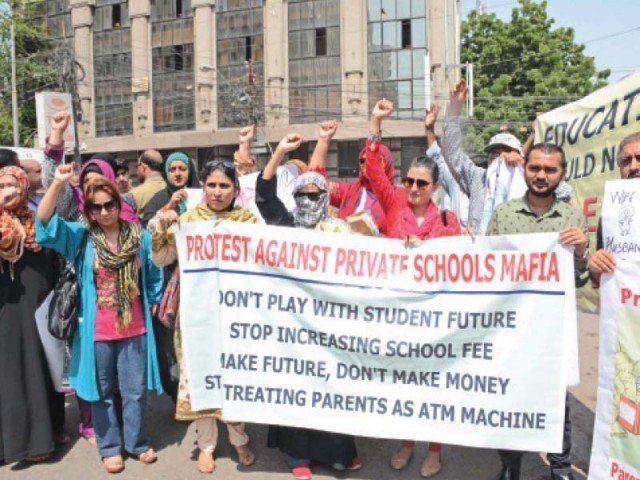
Truth Behind Private School’s Excessive Fees
Truth Behind Private School’s Excessive Fees: We all disagree with private schools fee structure, don’t we? Exorbitant fees, windfall profits, incompetent teachers and lack of facilities. Yet, our children are enrolled in private schools. Why don’t we send our children to government schools that have been established by our taxes?
Under article 25-A, the Constitution states that it is the states’ responsibility to provide education. Yet, 40% of children in Pakistan are getting the education in 1,73,110 private schools across Pakistan.
In 1994, there were 393 government schools in Islamabad. Twenty-five years later, there are 422. However, the population of the city has increased much more during that time: 500,000 to 2,200,000.
There are already 22 million out-of-school children in Pakistan. This decision can potentially lead to the shutdown of 2,000 schools in Islamabad, adding 3,50,000 more children to the above-stated figure. Furthermore, 38,000 teachers may also lose their jobs.
On average, our government spends Rs.1,412 per child per month on elementary education in government schools.
Whereas, the US spends Rs.1,14,243, Australia Rs.98,466, Sweden Rs.1,15,016 and the UK Rs.97,148. We are quick to draw comparisons between education in Pakistan and education abroad without realizing that quality education is a costly commodity.
From teacher training to resources, premises, administration, facilities, retaining good teachers, everything costs money.
We landed in Ivy Leagues, and Fortune 500s because of these private schools.

Private school Are Not Government Funded And Subsidized
Private schools are neither funded nor subsidized by the government. They are taxed like any other business. Every school pays 33% income tax, 17% GST, 3% super tax, 6% Employees Old-Age Benefits Institution (EOBI), 6% social security and heavy property commercialisation fees or commercial rents. They are established when people invest their hard earned money to build them and hence, have a right to a return on investment.
Is it fair to charge a summer fee? During this summer, schools have:
- teachers and admin members to pay salaries to
- support staff members to pay salaries to
- school rent
- Internet, electricity and telephone bills and multiple online subscriptions to pay
- international consultants to pay, who are working on the professional development of the teachers
- Repairs, renovation, new furniture and new annual resources (books, notebooks, stationery, equipment, manipulative and so on) to pay for.

For those who might be familiar with how schools work, summer is one of the most work-intensive times of the year schools have to prepare for an entire academic year.
Instead of fighting for fee raise and hike fight for quality government schools, said by a private school head.
For More Information & Videos Subscribe To Our YouTube Channel